Handbook of Attachment, Third Edition: Theory, Research, and Clinical Applications by Jude Cassidy & Phillip R. Shaver
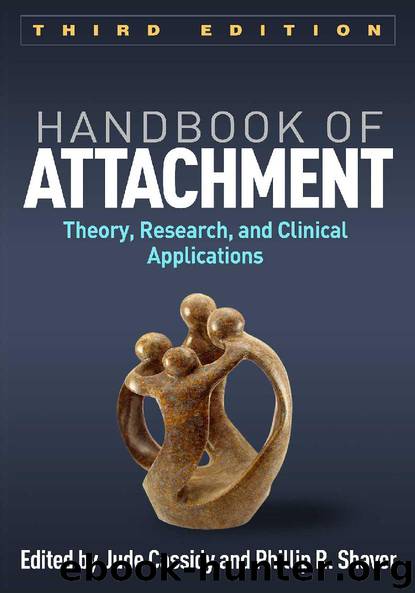
Author:Jude Cassidy & Phillip R. Shaver
Language: eng
Format: epub
ISBN: 9781462525317
Publisher: Guilford Publications
Published: 2016-06-13T00:00:00+00:00
Stability and Change in Attachment Styles
Although attachment styles are thought to be relatively stable, with some research even indicating that attachment styles are trait-like (e.g., Banai, Weller, & Mikulincer, 1998), Bowlby’s model of attachment patterns was quite accommodating of change (Bowlby, 1973; Fraley & Brumbaugh, 2004). A review of the child development literature by Campos, Barrett, Lamb, Goldsmith, and Stenberg (1983) indicated that, averaged over seven studies, 32% of infants and toddlers showed a change in classification over time. Similar rates have been reported in young adult samples (Baldwin & Fehr, 1995), and rates as high as 46% have been reported in studies of adults undergoing particularly acute stress (Cozzarelli, Karafa, Collins, & Tagler, 2003).
The literature on stability and change in later adulthood is far more limited. Indeed, at this point there are only two longitudinal studies that address this issue, both of which examined changes in attachment over a 6-year period. One study involved a sample of 370 relatively affluent, highly educated, predominantly European American men and women between ages 15 and 87 years (Zhang & Labouvie-Vief, 2004). The other involved 415 less affluent, less well-educated older adults (60% African American, 40% European American) who were 72 years old at the first time of measurement and 78 years old at the second (Consedine & Magai, 2006). The former study indicated that both secure and dismissing attachment increased over time; the latter study indicated that both decreased over time. The discrepancy in findings is probably related to the pronounced demographic differences between the two samples, including the age ranges studied. It may also be due to the fact that the first study relied on simple paragraph measures of attachment style, whereas the latter used the 30-item Relationship Scales Questionnaire (Bartholomew & Horowitz, 1991). In the case of the exclusively later-life sample, Consedine and Magai (2006) suggested that the unexpected decrease in both security and dismissiveness (compared with previous cross-sectional studies) relates to sample-specific changes in the purposes served by attachment figures in later life and changes in patterns of social network engagement and composition. That is, the decrease in security may reflect the loss of key members of social networks due to mortality. Conversely, decreases in dismissiveness may reflect a tendency in this sample, or age group, to place increasing value on intimate, emotionally rewarding relationships when one’s expected remaining time with them was limited.
Download
This site does not store any files on its server. We only index and link to content provided by other sites. Please contact the content providers to delete copyright contents if any and email us, we'll remove relevant links or contents immediately.
| Anthropology | Archaeology |
| Philosophy | Politics & Government |
| Social Sciences | Sociology |
| Women's Studies |
Cecilia; Or, Memoirs of an Heiress — Volume 1 by Fanny Burney(32562)
The Great Music City by Andrea Baker(32023)
Cecilia; Or, Memoirs of an Heiress — Volume 2 by Fanny Burney(31959)
Cecilia; Or, Memoirs of an Heiress — Volume 3 by Fanny Burney(31945)
We're Going to Need More Wine by Gabrielle Union(19054)
All the Missing Girls by Megan Miranda(16052)
Pimp by Iceberg Slim(14522)
For the Love of Europe by Rick Steves(14174)
Bombshells: Glamour Girls of a Lifetime by Sullivan Steve(14081)
Norse Mythology by Gaiman Neil(13379)
Talking to Strangers by Malcolm Gladwell(13376)
Fifty Shades Freed by E L James(13247)
Mindhunter: Inside the FBI's Elite Serial Crime Unit by John E. Douglas & Mark Olshaker(9350)
Crazy Rich Asians by Kevin Kwan(9297)
The Lost Art of Listening by Michael P. Nichols(7509)
Enlightenment Now: The Case for Reason, Science, Humanism, and Progress by Steven Pinker(7316)
The Four Agreements by Don Miguel Ruiz(6770)
Bad Blood by John Carreyrou(6626)
Weapons of Math Destruction by Cathy O'Neil(6285)
